Small gifts. A little night-sky wonder.
A pillow box SVG.
A sky full of possibilities.
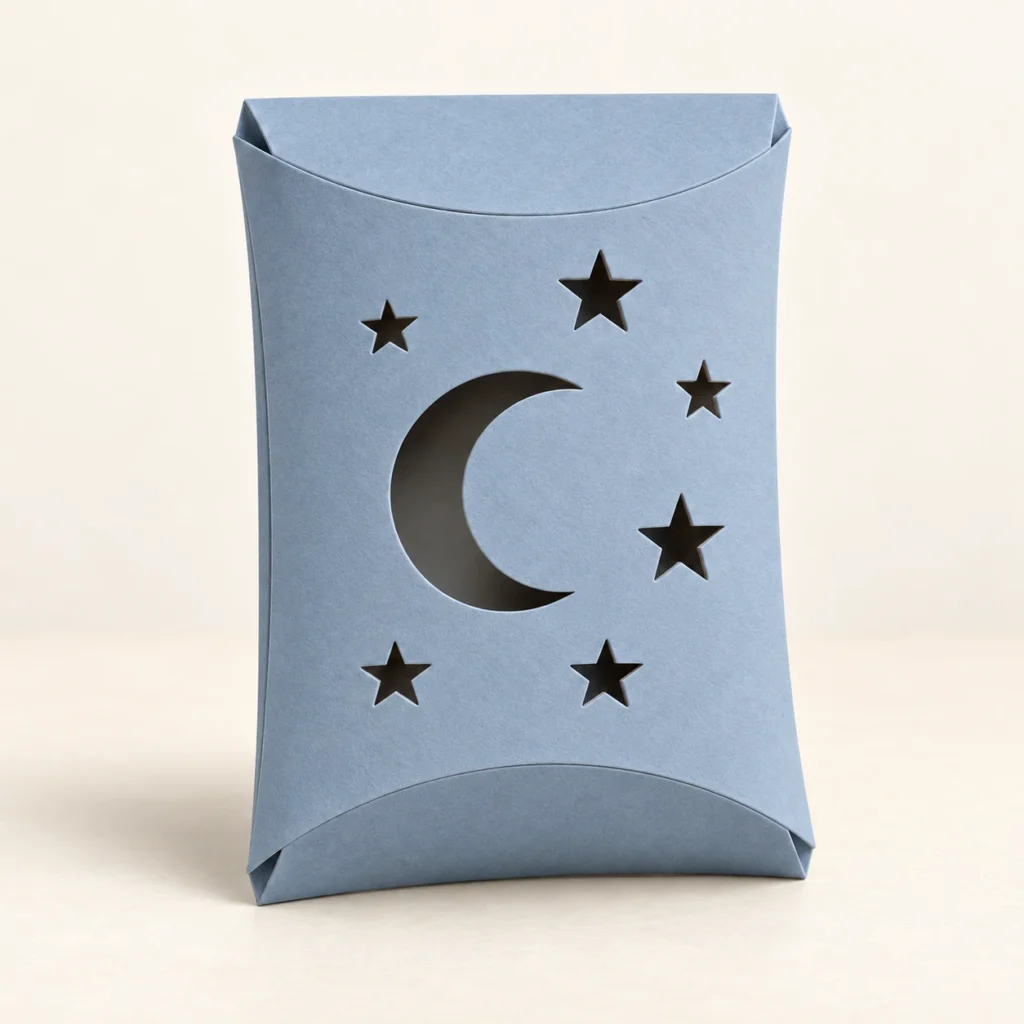
Orbit Fold is an original celestial pillow box SVG for foldable cardstock. A crescent moon and six star windows decorate its front, while a solid back, integral curved end flaps and a glued side seam form the pillow-style package. The ZIP includes one scalable SVG, an English preparation and assembly guide, and an annotated fold map. Original SVG page: 170 × 136 mm; flat artwork: 152 × 124 mm.
Folded softly.
Cut with a little wonder.
A quiet constellation turns a small gift into a thoughtful gesture. Orbit Fold combines a gently curved pillow-box form with an original arrangement of a crescent moon and six open star windows. Use your chosen approved cardstock and a personal finishing touch for a party favour, a small keepsake or a carefully wrapped present.
The box begins as one connected flat net. Its front and back share a fold; one glue flap closes the side seam, and four curved end flaps close the ends. There is no separate lid, wooden joinery, engraving or layered decoration to assemble.
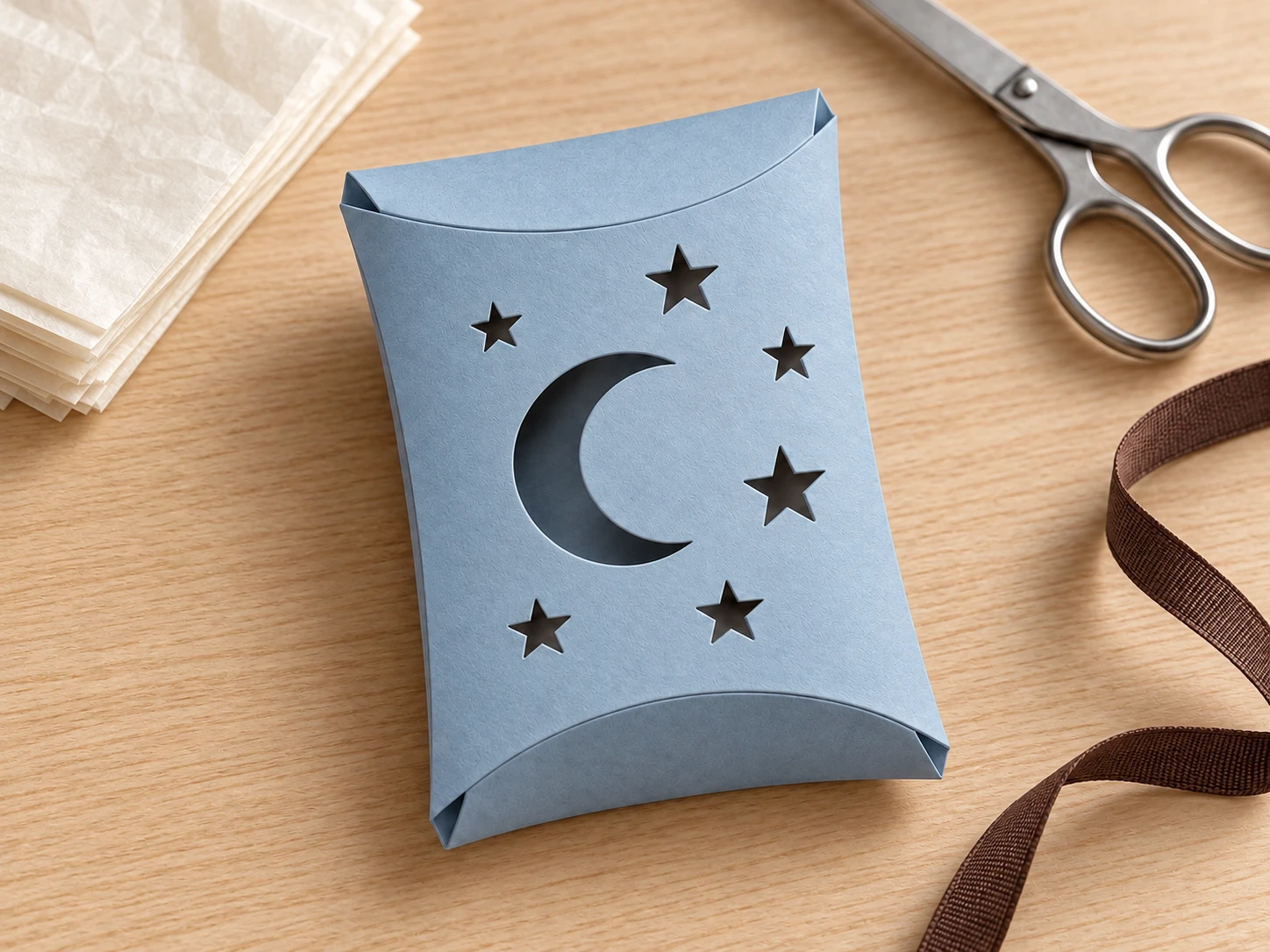
The images illustrate a possible finished appearance. A physical box, cardstock, adhesive, gift contents, lining and styling props are not included.
One considered net.
A clear file to prepare.
| Included files | One scalable SVG vector file, one English README and one annotated fold-map PNG, packaged in a ZIP archive |
|---|---|
| SVG page | 170 × 136 mm at original scale |
| Flat artwork bounds | 152 × 124 mm before stroke width; software may report artwork bounds instead of page size |
| Flat body panels | Two nominal 70 × 100 mm panels; the formed body curves during assembly |
| Closure and seam | Four integral curved end flaps and one 12 mm glue flap; no separate lid |
| Cut operations | 8 red (#FF0000), centered 0.025 mm closed contours: one outside net, one crescent moon and six star windows |
| Score operations | 6 blue (#0000FF), centered 0.025 mm open paths: two straight folds and four curved end-flap creases |
| File construction | Separate CUT and SCORE groups; no engraving, fonts, linked images or embedded raster artwork |
| Intended material | Foldable uncoated cardstock approved for the actual laser and wavelength; this is not a rigid wood or acrylic box |
| Finished size | Curvature, usable capacity and closure fit depend on stock, folds, kerf and assembly; no fixed finished depth is specified |
| Product type | Digital download only; no physical box, cardstock, adhesive, gift contents or styling props included |
| Product code | VD-OF-PB |
Check. Crease.
Shape your own sample.
-
Confirm the scale
Extract the ZIP and import the SVG. Verify the 170 × 136 mm page and 152 × 124 mm artwork bounds. Check both nominal 70 × 100 mm flat body panels and the 12 mm glue flap against the fold map.
-
Separate cutting and scoring
Use blue for a separately tested shallow score and red for cutting. Score first, cut the seven celestial windows next, and release the outside net last. Alternatively, disable the blue group during laser work and hand-crease the folds shown on the guide.
-
Form and close the pillow
Pre-crease the six fold paths, gently curve the body and join the right glue flap under the free left front-panel edge. Let the adhesive cure. Fold B1 inward before F1 at the top, and B2 before F2 at the bottom, following the fold map. Test closure with your intended wrapped contents before making a batch.
This design has not been physically test-cut, scored or assembled. Curvature, closure and usable capacity depend on stock, kerf, fold radius and assembly. No universal machine settings or fixed finished depth are supplied.
Your gift, thoughtfully wrapped.
The practical details.
What files will I receive?
The ZIP includes orbit-fold-celestial-pillow-box.svg, README.txt and fold-map.png. The SVG is the cutting and scoring artwork. The English README explains preparation, assembly and use terms; the annotated PNG is a guide, not a laser-processing file.
Is this pillow box made from wood?
No. Orbit Fold is drawn for foldable cardstock. Its curved body, integral end flaps and glued side seam rely on the material bending. Do not substitute rigid wood, plywood or acrylic and expect the same construction.
Are the moon and stars printed or engraved?
They are open cutout windows on the front panel: one crescent moon and six stars. The back panel is solid. No engraving or separate decorative pieces are required. Wrap small or delicate contents as needed, because the windows are open; lining and wrapping materials are not included.
How do I assemble and resize the box?
Follow the fold map to pre-crease the straight and curved folds and shape the body. Join the right glue flap under the free left edge of the front panel and let the adhesive cure. Close the top by folding B1 inward before F1, then close the bottom with B2 before F2. Scale the complete SVG proportionally if resizing. The glue flap, windows and fold allowances scale too. Make a fresh paper prototype and test closure fit before making a batch.
How do I prepare the file for Glowforge, xTool or Epilog?
Glowforge: Upload the SVG in the Glowforge App, verify the page and net dimensions, and assign red contours to Cut and blue fold paths to Score. Keep scoring settings separate from cutting, then inspect the job preview.
xTool Studio/XCS: Use the software and processing options supported by your model. Studio’s SVG import DPI setting can change the initial artwork size. Confirm the 152 × 124 mm net, assign red to Cut and blue to Score, and test shallow scoring on scrap stock.
Epilog: Open the SVG in suitable vector software and use your model’s driver or Dashboard workflow. In Illustrator, retain centered 0.025 mm vector strokes. Give blue fold paths a separate light vector pass from the red cutting contours. Follow the exact model’s guidance if using CorelDRAW.
Other CO₂/diode systems: Where LightBurn supports the actual controller, import the SVG and assign red to a Line cutting layer and blue to a different Line layer for shallow scoring. Check Preview and test the selected stock. A CO₂ or diode source alone does not establish software, controller or material compatibility.
If a suitable shallow score is unavailable, turn off output for the blue SCORE group, cut only the red contours, and hand-crease using the fold map. Do not process the guide PNG as an engraving.
Which cardstock and settings should I use?
Choose foldable, uncoated stock whose manufacturer confirms compatibility with your exact laser and wavelength. Check coatings, inks and any adhesive against your equipment instructions and material documentation. Glowforge’s material guidance explains why paper compatibility must be checked individually.
Make a scrap test for cutting and shallow scoring, then assemble a prototype. Apply adhesive after laser processing. Follow ventilation and continuous supervision guidance; keep the bed clear of scraps. No universal stock thickness, power, speed or pass count is supplied. This packaging is not represented as food-safe, waterproof or suitable for heavy contents.
Can I sell physical boxes I make?
Yes. Personal projects and sales of finished physical boxes you make are permitted. Do not resell, share or redistribute the digital files or modified digital versions. See the README for usage terms. A finished box, material, adhesive and contents are not included in this download.