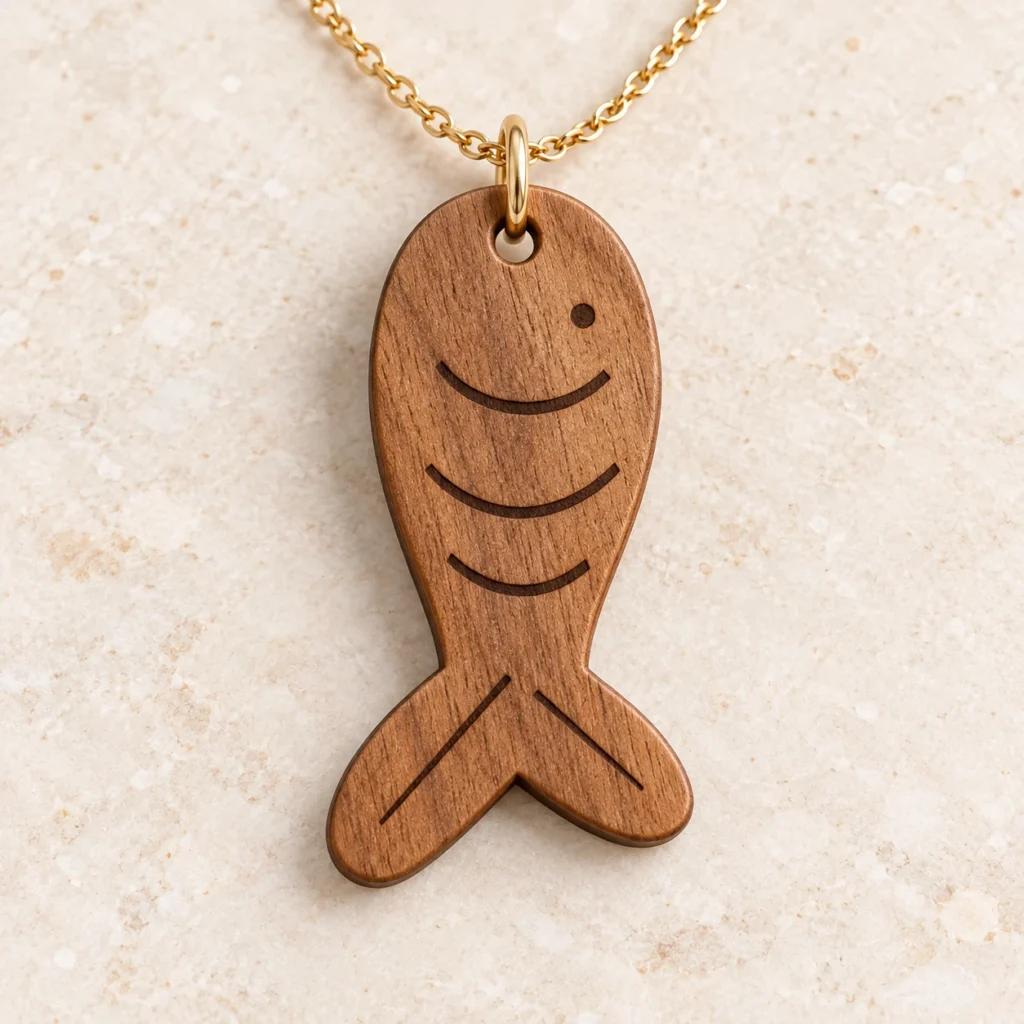
A quiet current. A flowing form.
A koi fish pendant SVG.
A small reminder to keep moving.
Koi Current is an original koi fish pendant SVG for laser-approved thin sheet wood. An upright, gently curved fish has a broad two-lobed tail and six surface-detail marks. One suspension hole sits near the top of the solid body. The ZIP includes one SVG, an English preparation and finishing guide, and an annotated cut map. The blank measures 26 × 48 mm before kerf and finishing; the original SVG page is 32 × 54 mm.
A fish in motion.
A pendant with a calm rhythm.
Koi Current brings the curve of a swimming fish to a single wood pendant blank. Its flowing body and surface details suggest movement without adding separate layers. Pair it with your own chain or cord and suitable findings to make a nature-inspired necklace or a small decorative charm.
The broad tail stays connected to the body across a nominal 10 mm span. An eye, curved gill, two current-like body bands and two tail marks are filled engraving shapes. They stay on the wood surface; the suspension hole is the only interior through-cut opening. The nominal minimum material rim around that hole is approximately 3.25 mm before kerf and finishing.
The images illustrate a possible finished appearance. Finished jewelry, wood, finishes, findings, chains, cords and styling props are not included.
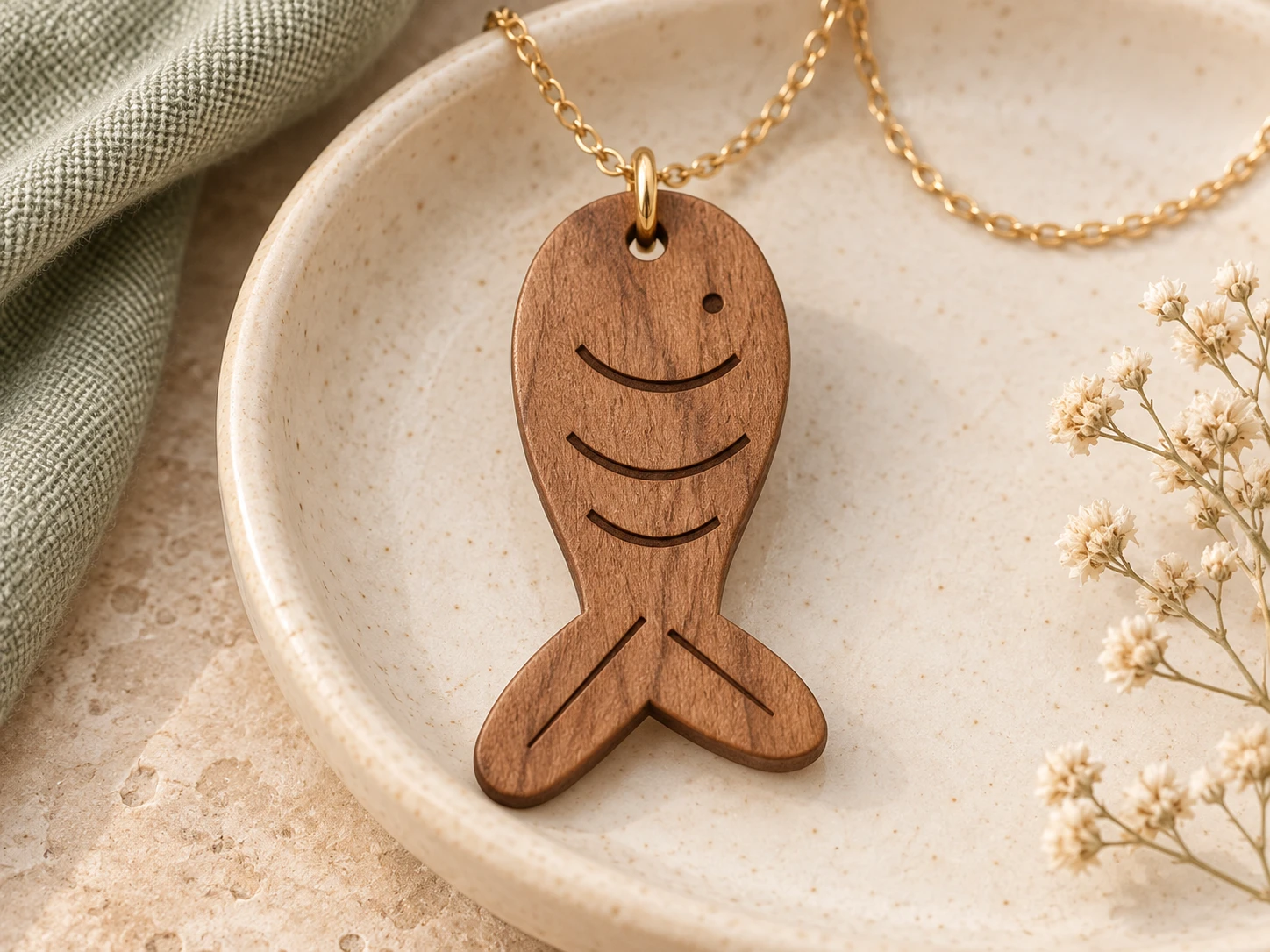
One continuous blank.
Separate surface detail.
| Included files | One scalable SVG vector file, one English README and one annotated cut-map PNG, packaged in a ZIP archive |
|---|---|
| SVG page | 32 × 54 mm at original scale |
| Artwork bounds | 26 × 48 mm before stroke width; confirm the usable machine work area |
| Blank size (W × H) | 26 × 48 mm before kerf and finishing; hardware is additional |
| Layout | One upright koi pendant blank; artwork bounds 26 × 48 mm; no mirrored pair supplied |
| Suspension hole | One 2.5 mm diameter hole per blank; 3.25 mm nominal minimum material rim before kerf |
| Narrow features | 10 mm nominal tail-to-body joining span; 3.25 mm nominal minimum hole rim, rounded from the digital clearance check. Vector dimensions are not strength guarantees |
| Cut operations | 2 red (#FF0000) closed contours: one koi outline and one suspension hole; centered 0.025 mm strokes with no fill |
| Engraving operations | 6 black (#000000) filled closed paths: an eye, one curved gill, two body bands and two tail marks; filled surface engraving, not through cutting |
| Construction | One continuous blank; no decorative through windows or loose islands; separate CUT and ENGRAVE groups; no fonts or raster artwork |
| Intended material | Laser-approved thin sheet wood; illustrated 2–3 mm birch or walnut is an example only |
| Findings | User-supplied a suitable jump ring or bail and your own chain or cord; verify fit against the finished hole, rim and stock thickness |
| Product type | Digital download only; finished jewelry, materials, findings and styling props are not included |
| Product code | VD-KC-PD |
Mark the detail.
Release the koi silhouette.
-
Verify the blank and hole
Extract the ZIP and import the SVG. Confirm the 32 × 54 mm page, 26 × 48 mm artwork and 26 × 48 mm blank. Check the 2.5 mm hole and the 3.25 mm minimum rim in the guide and cut map. Keep the eye, three curved bands and two tail marks registered to the single koi outline.
-
Engrave before releasing the shape
Set the 6 black filled paths to shallow filled surface engraving. Set all 2 red contours to cutting. Engrave first, cut the suspension hole next, and release the outer silhouette last where the software supports that order. Review the complete job preview; colour alone does not set the operation.
-
Inspect, finish and fit the hardware
Make a sample in your approved wood. Inspect the grain, hanging area and the 10 mm nominal tail connection; reject a cracked or weakened blank. Smooth and finish with methods suitable for the stock, then measure the finished hole. Fit a suitable jump ring or bail and your own chain or cord that clear the actual wood thickness and hole rim. Recheck the finished assembly before use.
This design has not been physically test-cut, finished, assembled or wear-tested. Kerf, stock, grain, engraving depth and finishing affect fit and strength. No universal machine settings, finished weight or wearer-suitability claims are supplied.
A flowing fish motif.
Practical making answers.
What files will I receive?
The ZIP contains koi-current-fish-pendant.svg, README.txt and cut-map.png. The SVG holds the cut and filled-engraving artwork. The English guide covers dimensions, import preparation, finishing and usage terms. The cut map is a dimensioned reference image; use the SVG for machine operations.
What will I make?
One pendant or decorative charm blank for laser-approved thin sheet wood. The file supplies one fish silhouette with a connected two-lobed tail, six engraved details and one hanging hole. The blank is 26 × 48 mm before kerf, sanding or finish, so this is not the finished necklace length. You supply the wood and finish, plus a suitable jump ring or bail and your own chain or cord. This purchase supplies digital files rather than finished jewelry.
How are the koi details made?
The eye, curved gill, two body bands and two tail marks are six black filled shapes for shallow surface engraving. They are not separate cut-out pieces. Two red closed paths cut the outer fish silhouette and its 2.5 mm suspension hole. Engrave the details while the blank remains in the sheet, then cut the hole and outer boundary.
How do I choose findings and resize the design?
The 2.5 mm hole is a nominal vector size. Measure the finished hole after cutting and finishing, and match ring wire to that opening. Choose ring inner diameter and opening range to clear the actual sheet thickness and the measured hole-to-edge distance at your attachment point. The nominal minimum hole rim is 3.25 mm before kerf; this alone does not determine ring size. Use a suitable jump ring or bail and your own chain or cord; open and close findings correctly rather than forcing them through the wood.
Scale the complete design proportionally, including both operation groups. Resizing also changes the 2.5 mm hole, the 3.25 mm minimum rim and every narrow feature. Recheck those dimensions after scaling, make a fresh sample and choose hardware for the resulting geometry.
How do I prepare this SVG for Glowforge, xTool or Epilog?
Glowforge: Upload the SVG, verify dimensions and work area, then assign red contours to Cut and black fills to Engrave. Review both operations for your model.
xTool Studio/XCS: Use software supported by your model. SVG import DPI can change scale; verify the blank dimensions. Assign red to Cut and black filled shapes to Engrave.
Epilog: In Illustrator, preserve the centered 0.025 mm red vector strokes and black fills. Set separate cutting and raster engraving processes through your exact model’s driver or Dashboard; check the preview.
Other CO₂/diode systems: If the controller is supported, import into LightBurn. Use red Line for cutting and black Fill for engraving. Review Preview; laser source alone does not establish compatibility.
Which wood and laser settings should I use?
Use laser-approved thin sheet wood. The illustrated 2–3 mm birch or walnut is an example, not a required or tested thickness. Confirm the actual wood, glues and coatings for your exact machine and wavelength with the supplier and material guidance.
Test engraving and cutting on scrap, then make a sample blank before a batch. Check grain, narrow features, hole edges and any cracking after finishing. No universal power, speed, pass count or finish is supplied. Follow your machine’s ventilation and supervision instructions. Materials and findings determine the finished weight, strength and wearer suitability.
Can I sell the physical pendants I make?
Yes. Personal projects and sales of finished physical pendants you make are permitted. Do not resell, share or redistribute the digital files or modified digital versions. See the README for the full usage terms. Wood, finishes, findings, chains or cords, tools and styling props are not included.