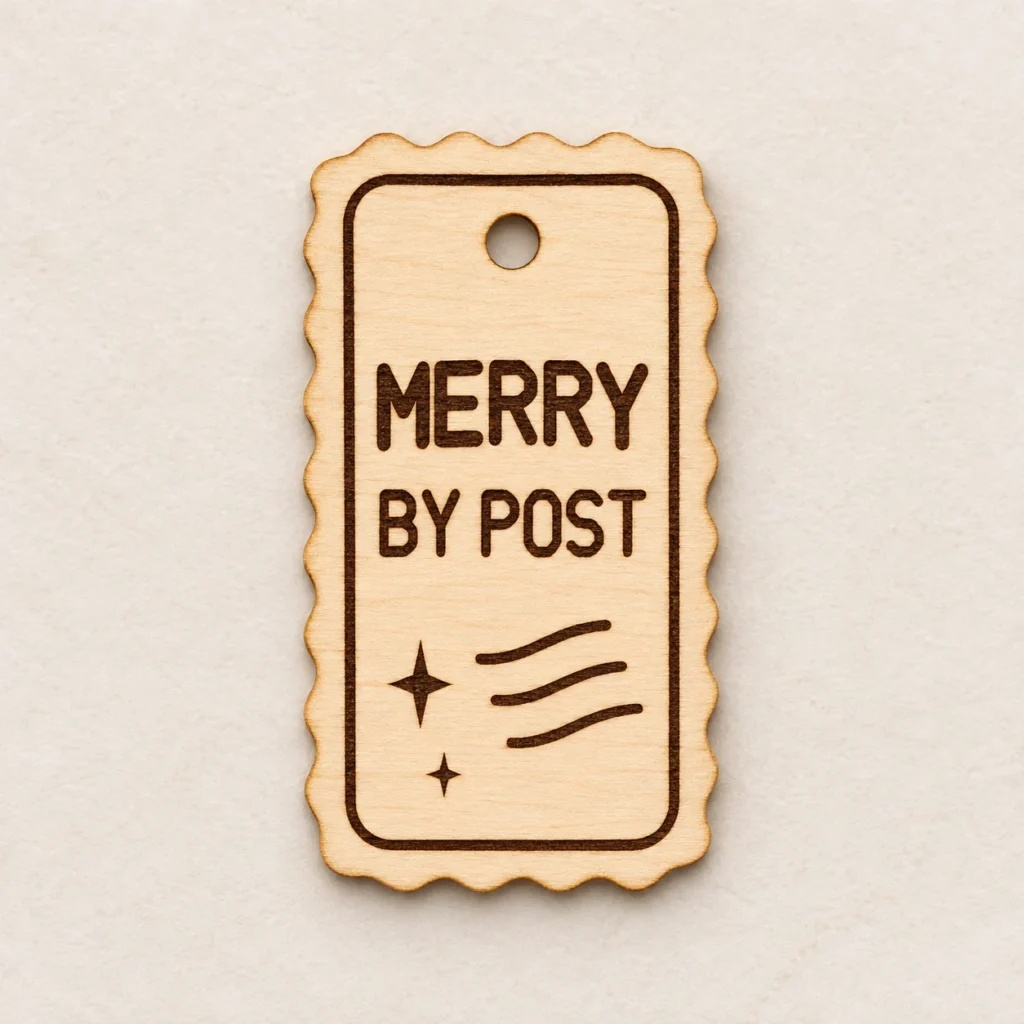
A Christmas greeting on a wooden key fob
MERRY BY POST on a tall stamp outline
Noel Post is a Christmas keychain SVG for making a one-piece wooden fob. Its scalloped edge recalls a postage stamp. The original MERRY BY POST lettering sits above three angled cancellation lines.
A short greeting above an angled postmark
MERRY and BY POST sit on separate lines. The compact outlined lettering fits the narrow tag face, and the three slanted marks finish the lower half like a postmark.
Images illustrate a possible finished appearance. The download contains digital files. Supply your own stock, hardware and finishing materials.

Size, cut paths and mounting
| Download | design.svg, README.txt and design-map.png in a ZIP |
|---|---|
| Cut profile | Single tall stamp-shaped key fob with a scalloped edge, 30 × 55 mm |
| SVG page | 40 × 65 mm |
| Hardware holes | One 4 mm round upper cut hole |
| Red cut paths | Two closed red contours for the scalloped profile and hardware hole. Centered 0.025 mm strokes. |
| Black engraving | Three angled cancellation lines and original outlined MERRY BY POST lettering |
| Material | One layer of uncoated plywood approved for the exact machine and operations. Nominal 2–3 mm stock is a prototype starting point where supported. |
| SKU | VD-NP-KEY |
Dimensions describe the vector geometry before kerf. The finished hole diameter and remaining material depend on stock and machine settings.
Cut, engrave and fit the hardware
-
Import and check scale
Extract the ZIP and import design.svg at its supplied size. Preview the small scallops and the 4 mm hardware hole as cuts. Check legibility of the smaller BY POST line and the three cancellation marks on scrap.
-
Assign each operation
Set the black fills to engraving and the red paths to through-cutting. Where your software supports it, engrave first, cut the holes and any inner openings next, then release the outer profiles.
-
Check the finished fit
Select a jump ring or split ring that passes through the finished hole and clears the wood around it. Prototype on the intended stock and check the assembly before putting it into use.
The geometry was verified digitally. Make a physical prototype to check cutting, engraving contrast, material strength and hardware fit before producing multiples.
Prepare the SVG for your laser
Glowforge. Import the SVG in the app supported by your model. Verify the cut size, set black to Engrave and red to Cut, and preview the operation order.
xTool Studio or XCS. Use the software your machine supports and check the SVG import DPI. Confirm the size in millimeters. Assign the black fills to Engrave and the red vectors to Cut.
Epilog. Use Pulse SVG import on supported models and firmware. In a vector editor and Dashboard workflow, retain the centered 0.025 mm red strokes and confirm that they register as vectors. Route black fills to engraving.
CO₂ or diode lasers. Use an SVG workflow such as LightBurn with supported equipment. Use a cutting Line layer for red and an engraving Fill layer for black. Confirm the selected stock is suitable for your wavelength and test on scrap of the same material. Follow your machine’s exhaust and supervision instructions.
Common questions
What comes with the digital download?
The ZIP contains design.svg, README.txt and design-map.png. Use the SVG for machining. The PNG explains the operation colors and the English guide covers setup and fit. Supply your own wood and hardware.
Are the words MERRY BY POST editable text?
The words are supplied as fixed outlined engraving paths. Edit the vector outlines in a working copy if you want to alter the design. The key fob outline measures 30 × 55 mm and the hardware hole is nominally 4 mm.
Can I use the file with a CO₂ or diode laser?
Use the SVG workflow supported by your controller. Check that the machine manufacturer approves your plywood, including its glue and thickness. Verify the imported size and test both operations on matching scrap.
Can I resize the design or sell the pieces I make?
Scale all cut and engraving paths together and check the hardware fit and remaining wood around the holes. You may sell finished physical pieces you make. See the README for the digital-file terms.